
AMRready4KARL: Results of the Kick-off Workshop ‘Methodological Diversity’ – Taking Stock of PCR-Based Monitoring of Antimicrobial Resistance Genes in Wastewater
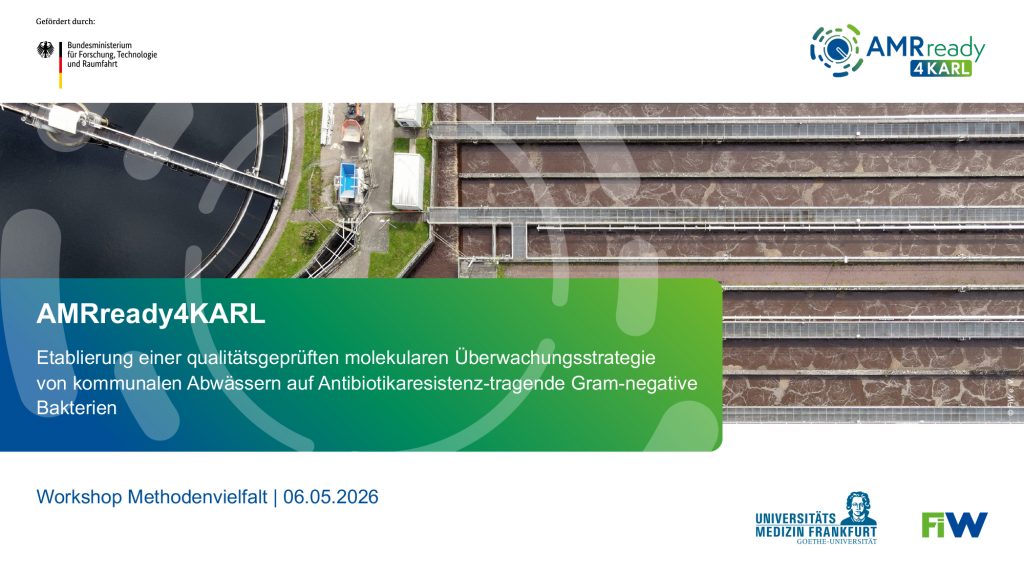
On 29 May 2026, the research project AMRready4KARL funded by the German Federal Ministry of Research, Technology and Space held a virtual kick-off workshop on “Method Diversity”. The project consortium consists of the Research Institute for Water Management and Climate Future at RWTH Aachen University (FiW), the Institute for Medical Virology, and the Institute for Medical Microbiology and Infection Control at University Medicine Frankfurt. AMRready4KARL is also actively supported by the associated partners Emschergenossenschaft and Lippeverband (EGLV), the North Rhine-Westphalia State Agency for Nature, Environment and Climate (LANUK) and the Health Protection Authority Frankfurt am Main. Around 50 participants from the German AMELAG network, the water sector, and the public health service accepted the consortium’s invitation to discuss the current state of PCR-based methods for antimicrobial resistance monitoring in municipal wastewater and to contribute their expert input. The results of the accompanying survey provide the consortium with valuable insights for the development of quality-assured and standardized reference material for antimicrobial resistance monitoring in wastewater.
The revised EU Urban Wastewater Treatment Directive (EU-UWWTD) will require PCR-based monitoring of antimicrobial resistance (AMR) in bacteria carrying antimicrobial resistance genes in urban wastewater (wastewater-based epidemiology, WBE). However, suitable standardized methods for quality assurance and quality control in AMR-WBE are still largely lacking. Therefore, AMRready4KARL aims to develop and apply quality-assured and standardized reference material based on virus-like particles (VLPs) for the environmental diagnostics of multi-resistant Gram-negative bacteria and AMR genes in wastewater. Built from papillomavirus capsid proteins, these particles are environmentally stable, non-infectious, and can be spiked directly into raw wastewater. For the first time, they are intended to enable interlaboratory comparisons for harmonizing analytical methods in AMR-WBE, analogous to the AMELAG proficiency test for SARS-CoV-2.
To evaluate the practical applicability of VLPs for AMR-WBE, all relevant stakeholders from the German AMELAG network, the water sector, and the public health service were asked about the methods they currently use. A live survey allowed participants to anonymously share information on their laboratory methods and experience in real time.
The survey covered requirements for future reference materials and interlaboratory comparisons in AMR-WBE, as well as current detection practices. Almost 90% of participants reported experience with wastewater-based monitoring of viruses. By contrast, fewer than half of the participating laboratories stated that they already perform AMR-WBE. The detailed survey on the methods used, ranging from sample pre-treatment, sample processing, and nucleic acid extraction to PCR analysis, revealed substantial methodological diversity in AMR-WBE. At the same time, the results showed that WBE for AMR and viruses are not methodologically separate fields: laboratories often use comparable workflows and, in many cases, similar methods for both applications.
These findings highlight the practical potential of VLPs as reference material for AMR-WBE. Following this initial assessment, the development of initial VLP-based reference materials has already been initiated, and necessary preparations for their production are currently underway.
The AMRready4KARL consortium sincerely thanks all workshop participants for their valuable contribution.